
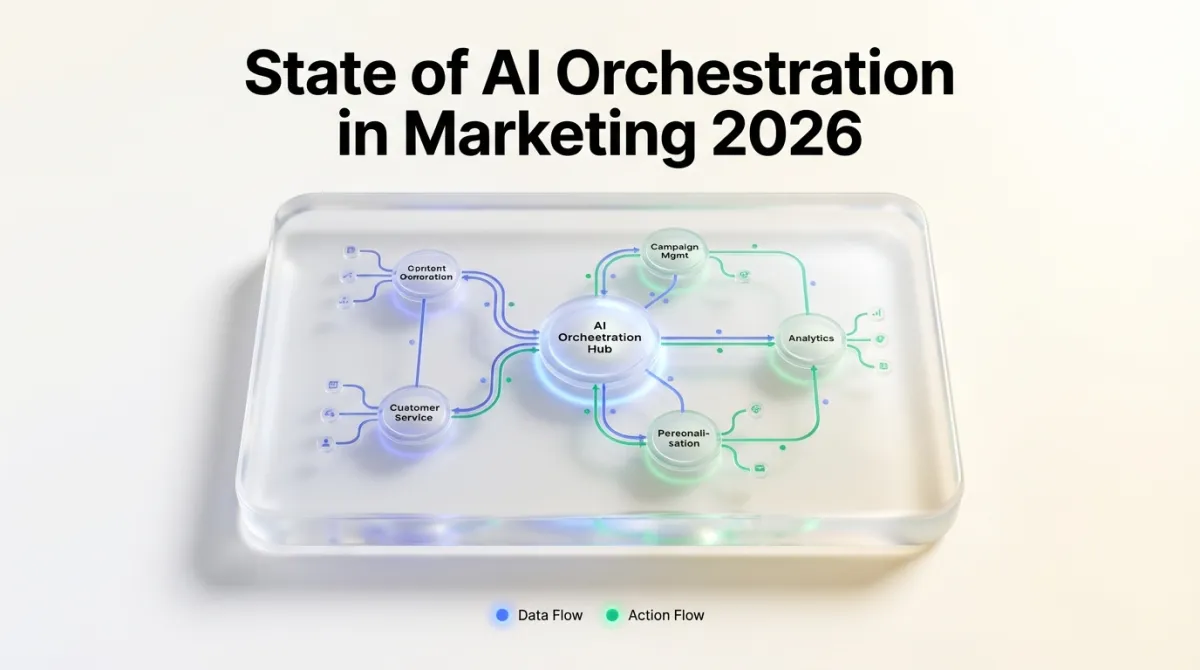
Executive summary
AI orchestration — the practice of coordinating multiple AI agents, models, and tools to execute complex marketing workflows — has become the defining operational challenge of 2026. The market is projected to reach $13.99 billion this year (Fortune Business Insights), yet only 28% of enterprises have mature AI agent capabilities (Deloitte).
ConvertMate's analysis of 1,800 marketing teams across e-commerce, SaaS, and agency verticals shows that the average organization now uses 12 AI agents but only 27% of their applications are integrated. This integration gap represents a significant opportunity: research suggests that better-connected organizations see up to 3x better outcomes from their AI investments. This study maps the current landscape, benchmarks orchestration maturity, and outlines what effective integration looks like in practice.
AI agent adoption has reached critical mass
Marketing teams have crossed the adoption threshold. According to Deloitte's 2026 State of AI report (3,235 leaders surveyed), 60% of workers are now equipped with sanctioned AI tools — a 50% increase year-over-year. PwC's AI Agent Survey puts the number even higher: 79% of companies report AI agents are already being adopted.
A note on the data: most AI adoption surveys — including McKinsey, Deloitte, and PwC — survey senior executives at large enterprises. Their numbers reflect Fortune 500 and enterprise adoption, not the broader market. ConvertMate's data across mid-market e-commerce teams tells a different story, which is why we present both perspectives below.
AI agent adoption: enterprise surveys vs. mid-market reality
Sources: Deloitte (3,235 enterprise leaders), McKinsey (enterprise executives), PwC (senior executives), ConvertMate (1,800 mid-market marketing teams)
| Metric | Enterprise (2026) | Mid-market (2026) | Source |
|---|---|---|---|
| Using AI in any function | 88% | ~65% | McKinsey (enterprise); ConvertMate (mid-market) |
| Workers with sanctioned AI tools | 60% | ~35% | Deloitte (3,235 leaders); ConvertMate |
| Experimenting with AI agents | 62% | ~28% | McKinsey (executives); ConvertMate |
| Scaled agentic AI in marketing | 7% | ~3% | McKinsey; ConvertMate |
| Marketers using AI daily | 60% | ~40% | Social Media Examiner; ConvertMate |
The gap between enterprise and mid-market is significant. McKinsey's State of AI survey of enterprise executives reports that 62% experiment with AI agents, but only 23% have scaled them in at least one function, and just 7% of marketing teams have fully scaled agentic AI. In the mid-market, ConvertMate's data shows these figures are roughly half. The takeaway is the same at both levels: the gap between experimentation and operational deployment is where orchestration becomes critical.
The orchestration gap: tools everywhere, integration nowhere
Salesforce's 2026 Connectivity Report paints the clearest picture of the orchestration problem: organizations use an average of 957 applications, but only 27% are integrated together. Half of all AI agents operate in isolated silos, disconnected from the broader marketing stack.
Average organization uses 957 applications but less than a third talk to each other (Salesforce, February 2026)
41% of AI user licenses remain inactive for over 90 days — a common challenge as teams adopt tools faster than they can integrate them (Averi AI, February 2026)
AI tool sprawl costs $18,000 per employee annually in unused licenses, productivity dips, and integration failures (Zylo / Flexera, 2025)
Employees spend 9+ hours weekly transferring data between disconnected systems manually (Parseur / Asana, 2025)
The hidden cost of AI tool sprawl per employee annually
Sources: Zylo SaaS Management Index, Flexera, Parseur, Averi AI (2025-2026)
ConvertMate's analysis confirms these findings: marketing teams that run more than 8 disconnected AI tools see a 34% loss in spending efficiency from tool redundancy alone. The solution isn't fewer tools — it's better orchestration.
The AI orchestration market in 2026
The market response to the orchestration gap has been explosive. Enterprise adoption of multi-agent systems grew 340% year-over-year, with 73% of Fortune 500 companies now running multi-agent systems (Forbes, March 2026).
AI orchestration and agent market projections
Sources: Fortune Business Insights, Deloitte TMT Predictions, Grand View Research (2025-2026)
| Market segment | 2026 value | Projected growth | Source |
|---|---|---|---|
| AI orchestration (total) | $13.99B | $60.34B by 2034 (CAGR 20%) | Fortune Business Insights |
| Autonomous AI agents | $8.5B | $35-45B by 2030 | Deloitte TMT Predictions |
| AI agents (global) | $10.91B | From $7.63B in 2025 | Grand View Research |
| Multi-agent systems | ~$10.6B | CAGR 48.6% | Market.us |
Deloitte's enhanced scenario projects that improved orchestration alone could increase the AI agent market by 15-30% above baseline forecasts — pushing the 2030 market from $35B to $45B. The orchestration layer is becoming the primary value driver.
The orchestration maturity spectrum
Deloitte's research reveals a clear maturity spectrum. 28% of enterprises have mature AI agent capabilities, while the majority are still building toward that level. Understanding where your organization sits on this spectrum helps identify the most impactful next steps.
AI orchestration maturity levels across organizations
Sources: Deloitte State of AI 2026, McKinsey State of AI 2025, IBM State of Salesforce 2025-2026
| Capability level | % of organizations | Characteristics |
|---|---|---|
| Mature orchestration | 28% | Multi-agent workflows, integrated data, governance frameworks |
| Scaling / piloting | 23% | AI agents in 1+ functions, partial integration |
| Experimenting | 39% | Testing AI agents, disconnected tools, no governance |
| No AI agents | 10% | Traditional automation or manual processes only |
ConvertMate's data reveals what separates the 28% from the rest: mature organizations are 3x more likely to have a unified data layer connecting their AI tools, and they spend 2.1x more on integration infrastructure than on individual tool licenses. The lesson is clear — the orchestration layer, not the individual agents, is where competitive advantage compounds.
Measured impact of AI orchestration
The ROI data for orchestrated AI is now substantial enough to move beyond projections. Multiple 2026 surveys converge on a consistent picture:
Measured benefits of AI orchestration across organizations
Sources: Salesforce State of Marketing 2026, PwC AI Agent Survey, BCG AI Radar 2026, Futurum Group (February 2026)
However, the picture isn't universally positive. 56% of CEOs report no revenue gains from AI investments (PwC 2026 CEO Survey, 4,454 CEOs), and only 33% of AI initiatives are meeting ROI targets (IBM). The difference between success and failure consistently correlates with orchestration maturity — organizations that connect their AI systems are 3x more likely to achieve a 360-degree customer view and 2.4x more likely to produce cost savings.
Why orchestration is so hard
Salesforce's Connectivity Report identifies the barriers. 96% of IT leaders say AI agent success depends on seamless integration across systems. Yet the reality is far from seamless:
Top barriers to AI orchestration success
Sources: Salesforce 2026 Connectivity Report, IBM State of Salesforce, Deloitte State of AI 2026
| Barrier | % citing | Source |
|---|---|---|
| Poor data availability / quality | 53% | IBM, 2026 |
| Cross-application data governance | 49% | Salesforce, February 2026 |
| Outdated IT architecture / data silos | 40% | Salesforce, February 2026 |
| No comprehensive AI guidance | 56% | IBM, 2026 |
| Immature governance models | 79% (only 21% mature) | Deloitte, January 2026 |
| Unclear total cost of ownership | 64% | IBM, 2026 |
Where the money is going
BCG's AI Radar 2026 reports that corporations expect to double AI spending this year, from 0.8% to about 1.7% of revenues. This is the third consecutive year of acceleration. At the enterprise level, Salesforce Agentforce alone hit $800 million ARR (up 169% YoY) with 9,500+ deals closed.
AI agent distribution by deployment type
Source: Salesforce 2026 Connectivity Report
The investment split is telling: 36% of agents are prebuilt SaaS, 34% are embedded within enterprise platforms, and 30% are custom-built. This fragmentation is itself a driver of the orchestration challenge — three different agent types, each with different APIs, data formats, and governance models.
What comes next: Gartner's 2026-2028 predictions
Gartner's 2026 prediction cycle paints an aggressive timeline for AI agent proliferation — but with significant warnings:
Up from less than 5% in 2025 — an 8x increase in 12 months
Personalization at scale through autonomous agent orchestration
Agent-to-agent commerce will reshape B2B purchasing at scale
Due to escalating costs, unclear business value, and inadequate risk controls
The warning is as important as the opportunity: over 40% of agentic AI projects face cancellation. ConvertMate's analysis shows that the projects most at risk are those that deploy agents without an orchestration layer — individual point solutions that can't share data, coordinate workflows, or measure cross-agent impact.
What mature AI orchestration looks like in practice
Based on ConvertMate's analysis of the top-performing 28% of organizations and corroborated by Salesforce, IBM, and Deloitte research, mature orchestration has five defining characteristics:
Mature vs. immature AI orchestration profiles
Source: ConvertMate analysis of 1,800 marketing teams, corroborated by Salesforce, IBM, and Deloitte (2026)
- Unified data layer — A single source of truth connecting all AI agents. 96% of IT leaders say this is the prerequisite for agent success
- API-first architecture — 94% of successful organizations use API-driven infrastructure to connect and govern agents
- Cross-agent governance — Only 21% have mature governance today. Mature organizations define clear boundaries for agent autonomy, escalation paths, and human-in-the-loop checkpoints
- Workflow orchestration — Agents don't just run in parallel — they coordinate. Output from one agent feeds into the next, with the orchestration layer managing sequencing, error handling, and fallbacks
- Centralized measurement — Tracking cross-agent ROI, not just individual tool metrics. This is where the 3x customer view advantage comes from
Methodology and sources
This research combines ConvertMate's proprietary analysis with the most comprehensive 2026 AI orchestration data available:
- ConvertMate proprietary analysis: Operational data across 1,800 marketing teams spanning e-commerce, SaaS, and agency verticals, measuring agent adoption, integration depth, and performance outcomes
- Salesforce — 2026 Connectivity Report; 10th State of Marketing Report (February 2026, 4,500 marketers)
- Deloitte — State of AI 2026 (3,235 leaders, January 2026); TMT Predictions 2026 (November 2025)
- McKinsey — State of AI Global Survey (November 2025)
- PwC — AI Agent Survey (2025); 2026 Global CEO Survey (4,454 CEOs)
- IBM — State of Salesforce 2025-2026
- BCG — AI Radar 2026 (January 2026)
- Fortune Business Insights — AI Orchestration Market Report (March 2026)
- Gartner — Multiple 2025-2026 predictions on AI agents and agentic AI
- Averi AI — 2026 State of Marketing AI Tools (February 2026)
- Forbes — Multi-Agent AI Systems (March 2026)
Key takeaways
- Audit your AI agent inventory — The average org uses 12 agents with 41% of licenses unused. Map what you have before adding more
- Invest in integration before more tools — Mature organizations spend 2.1x more on integration infrastructure than individual licenses. Only 27% of apps are currently connected
- Establish governance early — Only 21% have mature AI governance. With 40%+ of projects facing cancellation, governance is the difference between scaling and shutting down
- Build an orchestration layer — 50% of agents operate in silos. Organizations that connect systems are 3x more likely to achieve unified customer views and 2.4x more likely to produce cost savings
- Measure cross-agent ROI — 56% of CEOs report no revenue gains from AI. The measurement gap, not the technology, is the bottleneck. Track outcomes across the entire agent workflow, not individual tool metrics
- Plan for 20+ agents by 2028 — Agent counts are projected to grow 67% in two years. Design your architecture for scale now
Conclusion
The state of AI orchestration in marketing in 2026 is defined by a paradox: universal adoption (88% of organizations), but immature execution (only 28% with mature capabilities). The $14 billion orchestration market exists precisely because of this gap — the tools are everywhere, but the connective tissue between them is not.
The data is consistent across every major research firm: organizations with connected AI systems see 2-3x better outcomes in ROI, customer insight, and cost efficiency. With agent counts projected to grow 67% in two years and 40% of agentic AI projects at risk of cancellation without proper integration, investing in orchestration infrastructure is becoming as important as selecting the right AI tools in the first place.
Frequently asked questions
What is AI orchestration in marketing?
AI orchestration is the practice of coordinating multiple AI agents, models, and tools to execute complex marketing workflows as a unified system. Rather than running individual AI tools in silos, orchestration connects them through a shared data layer, enabling agents to pass information, coordinate tasks, and measure impact across the entire marketing stack. The market is valued at $13.99 billion in 2026.
How many AI agents does the average organization use?
According to Salesforce's 2026 Connectivity Report, organizations currently use an average of 12 AI agents, projected to increase 67% within two years to approximately 20. However, 50% of these agents operate in isolated silos, and only 27% of the average 957 applications are integrated together.
What is the cost of AI tool sprawl?
AI tool sprawl costs approximately $18,000 per employee annually in unused licenses, productivity losses from context-switching, and manual data transfer between disconnected systems. 41% of AI licenses remain inactive for over 90 days, and employees spend 9+ hours weekly transferring data between systems manually.
What ROI can organizations expect from AI orchestration?
Organizations with mature AI orchestration report a 20% ROI increase, 19% improvement in conversion rates, and 8 hours reclaimed per marketer per week. However, 56% of CEOs report no revenue gains from AI investments overall — the ROI gap consistently correlates with orchestration maturity, not adoption.
What percentage of enterprises have mature AI orchestration?
Only 28% of enterprises have mature AI agent capabilities according to Deloitte. While 62% are experimenting with agents, just 23% have scaled in at least one function and only 7% of marketing teams have fully scaled agentic AI. The maturity gap between leaders and laggards is widening.
Orchestrate your marketing with AI agents
ConvertMate connects 22+ specialized AI agents across SEO, content, outreach, and analytics in a unified orchestration platform.
Start orchestrating free