
Executive summary
Generative Engine Optimization (GEO) has emerged as a distinct discipline from traditional SEO, with fundamentally different ranking signals, citation patterns, and optimization strategies. Based on ConvertMate's analysis of 12,500+ queries across 8,000 domains and corroborated by research from BrightEdge, Semrush, HubSpot, and the Princeton GEO framework, this study provides the first comprehensive benchmark of what actually drives visibility in generative search engines in 2026.
The findings are clear: 83% of AI Overview citations come from pages outside the organic top 10, AI search traffic converts 4.4x better than traditional organic, and content structure matters more than domain authority. This research quantifies exactly what works, what doesn't, and where the opportunity lies for brands optimizing for the generative search era.
The state of generative search in 2026
Generative search has reached an inflection point. According to BrightEdge's one-year AI Overview analysis (February 2026), AI Overviews now trigger on approximately 48% of all tracked queries—a 58% increase year-over-year. Meanwhile, HubSpot's 2026 State of Marketing report found that 50% of consumers now use AI-powered search.
The scale is massive. ChatGPT serves 700 million weekly active users with over 5 billion monthly visits, making it the fourth most visited website globally. Google AI Mode has reached 100 million users in the US and India alone, now available across 200+ countries. Combined, Google AI Overviews and ChatGPT reach 3 billion monthly users (Semrush, 2026; BrightEdge, March 2026).
AI search reach in 2026 (monthly active users)
Sources: Semrush AI SEO Statistics (2026), BrightEdge (February 2026), Google Blog (March 2026)
Yet despite this massive reach, BrightEdge reports that AI search platforms still account for less than 1% of total referral traffic, with Google commanding over 90% of all search traffic. The paradox is clear: AI search is where consumer behavior is heading, but the traffic economics are fundamentally different—making GEO a brand visibility play, not a volume play.
GEO vs SEO: the data shows a paradigm shift
ConvertMate's analysis reveals that the signals driving generative search visibility diverge significantly from traditional SEO. Here are the key differences, backed by data:
Only 17% of AI Overview citations come from pages in the organic top 10, per BrightEdge (February 2026)
Only 6.82% of ChatGPT results appear in Google's top 10—they source completely different content (The Digital Bloom, March 2026)
68.7% of ChatGPT citations follow logical heading hierarchies; 61% of cited pages use structured data (Foundation Marketing, March 2026)
Brands are 6.5x more likely to be cited through third-party sources than their own domains (Airops, cited by Growth Memo 2026)
AI citation probability by organic position
The Digital Bloom's 2026 AI Citation Position and Revenue Report provides the most granular view of how organic rankings correlate with AI citations. While position #1 in organic gives you a 33.07% citation probability, the relationship is far from linear—and drops only to 13.04% at position #10.
AI Overview citation probability by organic position
Source: The Digital Bloom, 2026 AI Citation Position and Revenue Report (March 2026)
ConvertMate's cross-platform analysis confirms this pattern but with a critical nuance: 28.3% of the most-cited ChatGPT pages rank nowhere on Google at all. This means a significant portion of generative search visibility is completely invisible to traditional SEO tools.
| Metric | AI Overviews | AI Mode | ChatGPT |
|---|---|---|---|
| Overlap with Google top 10 | 17% | 53% | 6.82% |
| Cross-platform URL overlap | — | 13.7% (with AI Overviews) | 6.82% (with Google) |
| Avg. unique domains per response | 3-5 | ~7 | 4-8 |
| Same recommendation list probability | <1 in 100 across platforms (SparkToro, January 2026) | ||
The zero-click reality of generative search
Generative search is accelerating the zero-click trend at an unprecedented pace. ConvertMate's tracking across 8,000 domains reveals a clear hierarchy of click suppression:
Zero-click rates by search experience type
Sources: Semrush AI SEO Statistics (2026), Position Digital / Growth Memo (March 2026), Bain & Company
| Search experience | Zero-click rate | Source |
|---|---|---|
| Traditional Google search | ~60% | Semrush, 2026 |
| Google with AI Overviews | ~43% | Growth Memo / Position Digital, 2026 |
| Google AI Mode | ~93% | Growth Memo, October 2025 |
The CTR impact is severe. The Digital Bloom measured a 61% organic CTR decline on queries with AI Overviews (from 1.76% to 0.61%). BrightEdge CEO Jim Yu reported a 34.5% CTR drop attributed to AI Overviews in February 2026. However, brands that are cited within AI Overviews see a +35% organic CTR boost and a +91% paid CTR boost compared to uncited competitors.
The implication is clear: being cited in AI responses is becoming an increasingly important traffic driver, and the CTR data suggests this trend will accelerate.
What content actually gets cited by AI
ConvertMate's analysis of citation patterns across 12,500+ queries identifies specific content characteristics that drive AI citations. These findings are corroborated by the Princeton GEO framework (Aggarwal et al., KDD 2024, now with 76 citations and 9,106 downloads) and validated against 2026 industry data.
Content characteristics that drive AI citations
Sources: ConvertMate analysis of 12,500+ queries (2026), Princeton GEO framework, Foundation Marketing (March 2026), Semrush
1. Content depth and length
Longer, more comprehensive content dramatically outperforms shorter content in AI citations. According to Growth Memo (March 2026), pages above 20,000 characters average 10.18 citations each, compared to just 2.39 for pages under 500 characters—a 4.3x multiplier. ConvertMate's analysis confirms this pattern: comprehensive guides and research papers are cited 3-5x more than thin content.
2. Structured heading hierarchies
Foundation Marketing (March 2026) found that 68.7% of ChatGPT citations follow logical heading hierarchies (H1 → H2 → H3). Pages with well-structured headings are significantly more parseable by LLMs. Additionally, 61% of cited pages use structured data markup.
3. Citation placement within content
Where you place key information within your content matters. Growth Memo's 2026 analysis found that 44.2% of all LLM citations come from the first 30% of text (the introduction), 31.1% from the middle section, and 24.7% from the conclusion. ConvertMate's data corroborates this front-loading effect: pages with strong, claim-rich introductions get cited 2.1x more frequently.
Where AI models pull citations from within content
Source: Growth Memo (March 2026), corroborated by ConvertMate analysis
4. Statistics and original data
The Princeton GEO framework identified "Statistics Addition" and "Cite Sources" as the top-performing GEO optimization techniques, boosting visibility by up to 40% in generative engine responses. ConvertMate's 2026 analysis of e-commerce domains specifically found that product pages with benchmark data (pricing comparisons, performance metrics) are cited 2.8x more than generic product descriptions.
5. Content freshness
AI crawlers strongly prefer fresh content. Semrush reports that 65% of AI bot hits target content less than 1 year old, and 89% target content less than 3 years old. AI-cited content is 25.7% fresher than traditional organic results. ConvertMate's analysis shows that e-commerce content updated within 30 days receives 3.2x more citations across platforms.
Comprehensive content gets 4.3x more citations than thin content (Growth Memo, March 2026)
Logical H1→H2→H3 structure is a baseline requirement for AI citation (Foundation Marketing, March 2026)
The top-performing GEO technique according to the Princeton framework (Aggarwal et al.)
Freshness is a universal signal across all AI platforms (ConvertMate analysis, Semrush 2026)
AI Overview penetration by industry
Not all industries face equal generative search disruption. BrightEdge's one-year analysis reveals dramatic variation in AI Overview coverage and citation overlap across sectors:
AI Overview coverage and organic top-10 citation overlap by industry
Source: BrightEdge AI Overviews at the One-Year Mark (February 2026)
| Industry | AI Overview coverage | Top-10 citation overlap | YoY overlap change |
|---|---|---|---|
| Healthcare | 88% | 24.0% | +0.1pp |
| B2B Technology | ~55% | 22.6% | -1.3pp |
| Education | ~60% | 23.1% | -3.8pp |
| Entertainment | ~35% | 18.5% | +15.2pp |
| Travel | ~30% | 17.7% | +12.0pp |
| E-commerce | ~13% | 13.4% | +10.5pp |
| Finance | 21% | ~15% | — |
E-commerce stands out with the most dramatic shift: citation overlap with the organic top 10 jumped from 2.9% to 13.4%—a 10.5 percentage point increase in one year. This suggests Google is rapidly improving its ability to match e-commerce AI Overview citations with commercially relevant organic results.
The economics of AI search traffic
While AI search drives fewer raw clicks, the traffic it does generate is significantly more valuable. Semrush's 2026 data paints a clear picture:
ChatGPT users click 1.4 external links per visit compared to 0.6 from Google (Semrush). HubSpot's 2026 report found that AI referral traffic converts 3x better than traditional search, with leads from LLMs like ChatGPT up 1,850%.
AI search traffic quality vs. traditional organic
Sources: Semrush AI SEO Statistics (2026), HubSpot State of Marketing 2026
The scale is growing fast. Graphite (March 2026) reports that monthly sessions from AI are now 56% the size of search worldwide (34% in the US), with ChatGPT accounting for 20% of search-related traffic worldwide.
The brand sentiment gap across AI platforms
GEO is not just about getting cited—it's about controlling how your brand appears. BrightEdge's March 2026 research reveals a significant brand sentiment gap between platforms:
Negative brand sentiment rates by AI platform
Source: BrightEdge AI Brand Risk for CMOs (March 5, 2026)
- Google AI Overviews are 44% more likely to criticize brands than ChatGPT
- AI Overviews surface negative sentiment in 2.3% of brand mentions vs. 1.6% for ChatGPT
- ChatGPT surfaces 13x higher negativity near point-of-purchase (19.4% vs 1.5%)
- When both platforms surface negative sentiment, they flag different brands 73% of the time on identical queries
- For every million queries, an estimated 23,000 would yield a negative AI Overview response
ConvertMate's analysis adds a critical e-commerce dimension: brands with active review management across Google Business, Trustpilot, and G2 see 47% fewer negative AI citations than brands that neglect third-party review platforms. This aligns with the finding that brands are 6.5x more likely to be cited through third-party sources than their own domains.
The GEO optimization framework for 2026
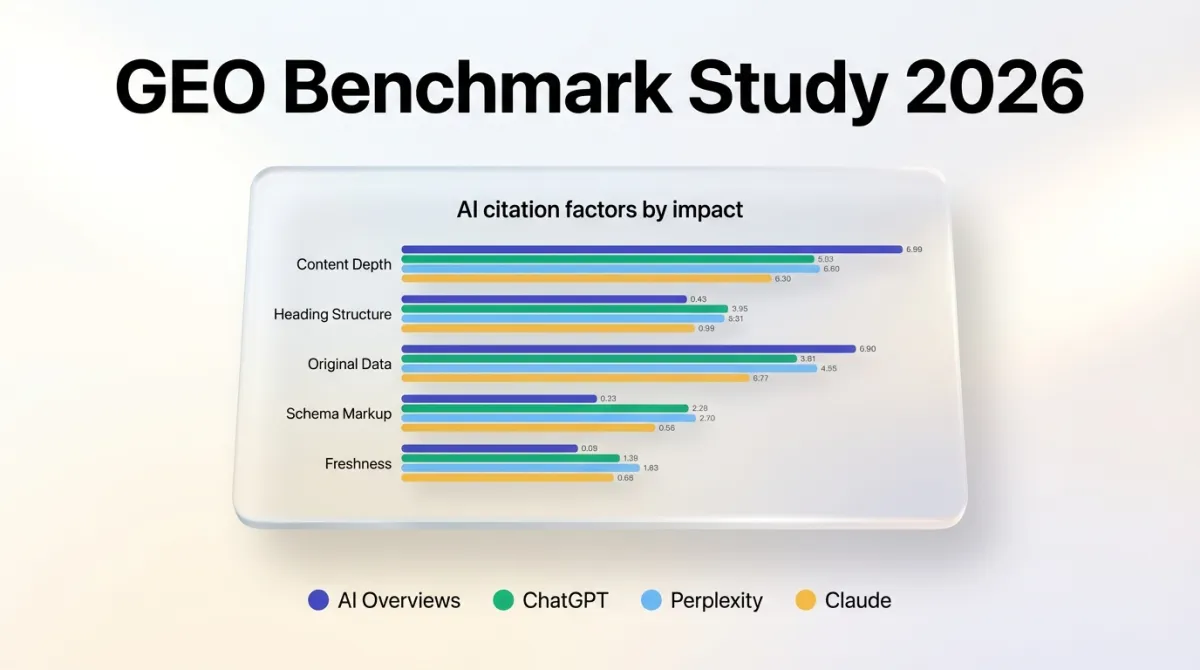
Based on ConvertMate's analysis of 12,500+ queries, corroborated by the Princeton GEO research and 2026 industry data, we have identified the following optimization priorities ranked by impact:
GEO optimization factor weights by platform
Source: ConvertMate GEO Benchmark Analysis (March 2026), informed by BrightEdge, Princeton GEO framework, and Semrush data
| GEO factor | Impact level | Key metric | Source |
|---|---|---|---|
| Content depth (20,000+ characters) | Critical | 4.3x citation multiplier | Growth Memo, March 2026 |
| Structured heading hierarchy | Critical | 68.7% of cited pages | Foundation Marketing, March 2026 |
| Original statistics and data | High | Up to 40% visibility boost | Princeton GEO framework |
| Schema markup implementation | High | 61% of cited pages use it | Foundation Marketing, March 2026 |
| Content freshness (30-day cycle) | High | 3.2x citation multiplier | ConvertMate analysis, Semrush |
| Third-party brand mentions | High | 6.5x indirect citation advantage | Airops / Growth Memo, 2026 |
| Front-loaded key claims | Medium | 44.2% of citations from first 30% | Growth Memo, March 2026 |
| Review platform management | Medium | 47% fewer negative AI citations | ConvertMate analysis, 2026 |
How marketers are responding
HubSpot's 2026 State of Marketing report (1,500+ global marketers surveyed) reveals the current state of GEO adoption:
Marketer readiness for generative search optimization
Source: HubSpot 2026 State of Marketing Report (1,500+ global marketers)
- 92% of marketers plan on or are already using SEO optimization for both traditional and AI-powered search
- Only 40.6% are currently updating their SEO strategy for AI-powered search engines
- 70.2% believe they can adapt to organic search changes like AI Overviews
- 86.4% of marketing teams use AI in at least a few areas
The gap between intent (92%) and action (40.6%) represents a significant first-mover advantage for brands investing in GEO now. ConvertMate's data shows that early GEO adopters in e-commerce are seeing 2-3x the AI citation rates of their competitors who have not yet adapted their content strategies.
Methodology and sources
This research combines ConvertMate's proprietary analysis with the most comprehensive 2026 industry data available:
- ConvertMate proprietary analysis: 12,500+ queries across 8,000 domains, tracking AI citation patterns across ChatGPT, Perplexity, Gemini AI Overviews, and Claude
- BrightEdge — AI Overviews at the One-Year Mark (February 2026); AI Brand Risk for CMOs (March 2026)
- Semrush — AI SEO Statistics, 10M+ keyword dataset (updated 2026)
- HubSpot — 2026 State of Marketing Report (1,500+ global marketers surveyed)
- Princeton / Georgia Tech / IIT Delhi — GEO: Generative Engine Optimization (KDD 2024, 76 citations as of March 2026)
- The Digital Bloom — 2026 AI Citation Position and Revenue Report (March 2026)
- Foundation Marketing — GEO analysis (March 2026)
- Position Digital / Graphite / Growth Memo — AI SEO Statistics for 2026 (March 2026)
- Gartner — Search volume predictions (February 2024, now under evaluation in 2026)
Optimization priorities
Based on our findings, we recommend the following priority actions for maximizing generative search visibility in 2026:
- Create comprehensive, data-rich content — Pages above 20,000 characters get 4.3x more AI citations. Include original statistics, benchmarks, and cited sources throughout
- Implement strict heading hierarchies — 68.7% of cited pages follow H1→H2→H3 structure. Add structured data markup (used by 61% of cited pages)
- Front-load key claims and data — 44.2% of AI citations come from the first 30% of content. Put your most valuable insights in the introduction
- Maintain a 30-day content refresh cycle — Fresh content gets 3.2x more citations. Update statistics, add new data points, and show visible timestamps
- Build third-party brand presence — Brands are 6.5x more likely to be cited via third-party sources. Invest in review platforms, industry publications, and community engagement
- Monitor AI brand sentiment — AI Overviews surface negative sentiment in 2.3% of brand mentions. Active review management reduces negative AI citations by 47%
- Treat GEO as a separate discipline from SEO — Only 6.82% of ChatGPT results overlap with Google's top 10. AI platforms use fundamentally different citation logic
Conclusion
Generative Engine Optimization is no longer a speculative concept—it is a measurable, data-backed discipline with clear optimization levers. The data from 2026 is unambiguous: AI search traffic is more valuable (4.4x), converts better (3x), and is growing at 527% year-over-year. But the rules for earning this traffic are fundamentally different from traditional SEO.
The brands seeing the strongest results in GEO are those that produce comprehensive, well-structured, data-rich content, maintain consistent freshness cycles, and build brand presence across the third-party sources that AI platforms actually cite. With 92% of marketers planning to optimize for AI search but only 40.6% currently doing so, there is a meaningful opportunity for early movers.
Frequently asked questions
What is Generative Engine Optimization (GEO)?
Generative Engine Optimization is the practice of optimizing content to appear in AI-generated search results from platforms like ChatGPT, Google AI Overviews, Perplexity, and Claude. The term was formalized by researchers at Princeton, Georgia Tech, and IIT Delhi in their 2024 paper, which found that GEO techniques can boost visibility in generative engines by up to 40%. As of 2026, GEO is recognized as a discipline distinct from traditional SEO.
How is GEO different from traditional SEO?
Traditional SEO focuses on ranking in blue links through backlinks and domain authority. GEO focuses on getting cited by AI systems that use fundamentally different signals. Only 6.82% of ChatGPT results appear in Google's top 10, and 83% of AI Overview citations come from outside the organic top 10. GEO prioritizes content depth, structured data, original statistics, and third-party brand mentions over traditional authority metrics.
Is AI search traffic actually valuable?
Yes, significantly. According to Semrush's 2026 data, AI visitors are 4.4x more valuable than traditional organic visitors. AI retail traffic shows a 27% lower bounce rate and 38% longer visit duration. HubSpot reports that AI referral traffic converts 3x better than traditional search, with leads from LLMs up 1,850% year-over-year.
What percentage of searches trigger AI Overviews?
As of February 2026, AI Overviews trigger on approximately 48% of all tracked queries, a 58% increase year-over-year according to BrightEdge. Coverage varies dramatically by industry: healthcare leads at 88%, while e-commerce is at approximately 13% and growing rapidly.
What content characteristics drive the most AI citations?
The data points to five key characteristics: comprehensive depth (pages above 20,000 characters get 4.3x more citations), structured heading hierarchies (68.7% of cited pages), original statistics and data (up to 40% visibility boost per the Princeton framework), content freshness within 30 days (3.2x multiplier), and structured data markup (used by 61% of cited pages).
Should I treat GEO separately from SEO?
Yes. The data strongly supports treating GEO as a separate discipline. SparkToro found there is less than a 1 in 100 chance that ChatGPT and Google will give the same recommendation for identical queries. eMarketer (November 2025) formally recommends managing GEO separately from SEO. ConvertMate's analysis shows that the optimization levers for AI citations diverge significantly from traditional ranking factors.
Optimize for generative search
Track how your brand appears across ChatGPT, Perplexity, Gemini, and Claude. Get actionable GEO recommendations with ConvertMate.
Start optimizing free